
10 Mistakes That Can Cost You Marks in MECEE-PG
StudyDote Editorial Team ·
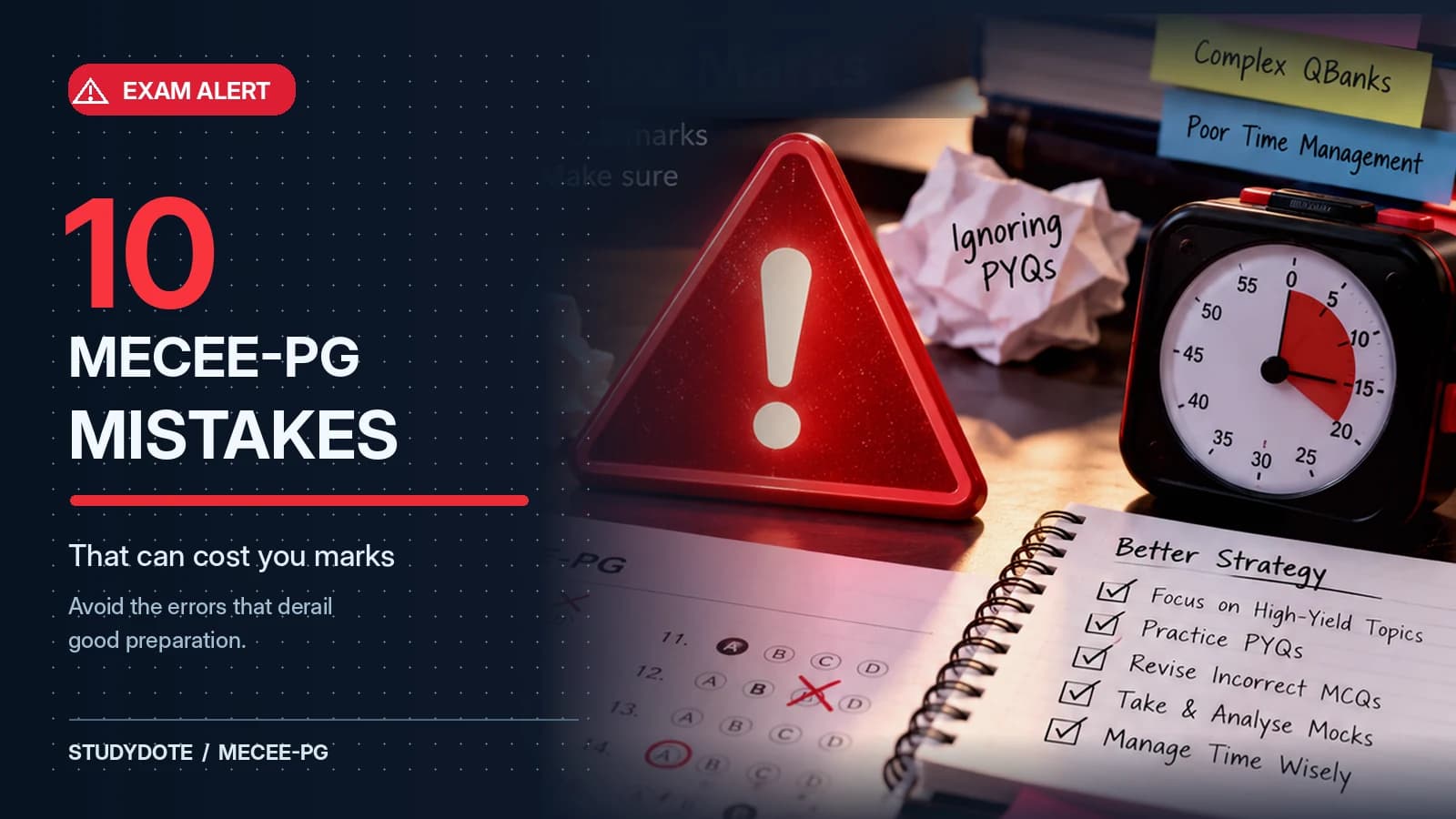
Sometimes the biggest threat to your MECEE-PG score is not a topic you never studied. It is an avoidable mistake in how you prepare, revise or attempt the paper.
If you are aiming for a strong rank, protect the marks your knowledge can already earn. This guide identifies ten habits that can reduce MCQ accuracy—and gives one practical correction for each. These are preparation and exam-technique risks, not claims that every student loses a fixed number of marks.
Switching between too many preparation platforms
Why it can cost marks: Jumping between Marrow, PrepLadder and new lecture sets repeatedly duplicates work and leaves less time for recall.
Do this instead: Choose one primary set of notes. Add a second source only to solve a specific difficulty, not because someone else recommends it.
Trying to finish the entire MBBS syllabus equally
Why it can cost marks: Equal attention to every topic can crowd out repeated revision of important, previously tested concepts.
Do this instead: Start with the official MEC syllabus, then use Nepal PYQs, relevant Indian PYQs and your incorrect-answer patterns to prioritize study time. Do not completely abandon untested syllabus areas.
Ignoring previous year questions from Nepal and India
Why it can cost marks: Random questions alone may not reveal the concepts historically tested in your target examination.
Do this instead: Practise MECEE-PG/Nepal PYQs first; use NEET-PG and INI-CET PYQs for supporting concept practice. For each missed question, explain the right answer and why distractors are wrong.
Taking mock tests without reviewing mistakes
Why it can cost marks: A score tells you how you performed, not why you lost marks. The same gaps can return in the next mock.
Do this instead: Classify each incorrect or guessed MCQ as a knowledge gap, stem-reading error, option confusion or timing issue. Fix the most repeated pattern before the next test.
Spending too much time on overly complex Indian QBanks
Why it can cost marks: Some Indian-platform questions go deeper than your current MECEE-PG priorities. Spending most of your time there can squeeze out more directly relevant practice.
Do this instead: Use the official MEC syllabus and Nepal PYQs as your anchor. Work on difficult Indian QBank questions when they strengthen an important concept, not simply because they are difficult.
Revising only the subjects you already know
Why it can cost marks: Familiar topics feel productive, while persistent weaknesses continue to cost marks.
Do this instead: Keep an incorrect-MCQ list. After every session, revisit at least one weak concept and re-attempt it later. Maintain your stronger areas with shorter recall checks.
Ignoring mandatory CPD
Why it can cost marks: An examinable component receives no preparation just because major subjects feel more urgent.
Do this instead: Include dedicated time for medical ethics, rational drug use, infection prevention, life-support principles and communication, according to the applicable MEC syllabus. Check the latest exam notice for current content.
Losing time on a handful of difficult questions
Why it can cost marks: Overinvesting in one difficult MCQ can leave easier questions unanswered.
Do this instead: Use timed mocks to set a personal threshold for moving on. When the exam interface allows it, flag time-consuming questions and return after attempting higher-confidence ones.
Misreading the task in an MCQ stem
Why it can cost marks: Missing words such as EXCEPT, INCORRECT, MOST LIKELY or NEXT BEST STEP can reverse the question being asked.
Do this instead: Before examining the options, restate the exact task: diagnosis, exception, mechanism or next action. Practise this under timed conditions until it becomes automatic.
Adding new resources when you need revision
Why it can cost marks: Starting more notes and lectures can crowd out retrieval practice for important material you studied earlier.
Do this instead: As your exam approaches, shift more time to weak-topic revision, incorrect MCQs, and mock analysis. Learn important untouched concepts selectively rather than restarting the whole syllabus.
Try this preparation reset before your next mock
- Choose your main notes: Pick one platform or notes set; stop comparing courses every week.
- Use evidence for priorities: Compare the official MEC syllabus with relevant Nepal and India PYQs.
- Save your errors: Record incorrect and uncertain MCQs by concept, and return to them after a delay.
- Review one mock properly: Separate knowledge gaps from timing and stem-reading mistakes.
- Plan CPD: Give the mandatory CPD component a real slot in your revision routine.
How StudyDote helps you avoid these mistakes
Keep the Marrow, PrepLadder or other legitimate notes that already work for you. StudyDote is designed to connect the next steps—not replace your primary learning resource.
- Topic-mapped Nepal and India PYQs help you practise concepts with historical exam relevance.
- PYQ-informed Daily Capsules help you prioritize daily practice without treating every topic equally.
- Incorrect-answer review returns missed MCQs to your revision workflow.
- Exam-pattern mock tests and performance analysis help expose gaps in accuracy, coverage and decision-making.
- Dedicated mandatory CPD preparation helps prevent leaving a syllabus component untouched.
See which MECEE-PG resources to keep and use our Top 100 high-yield topics as a starting priority list.
Frequently asked questions
Should I stop using Indian QBanks for MECEE-PG?
No. They are useful for additional conceptual practice. The mistake is spending so much time on advanced material that direct MECEE-PG priorities and your weak areas receive too little attention.
What should I do with an MCQ I get wrong?
Identify whether you misunderstood the concept or misread the task, review the explanation and relevant notes, then attempt the same concept again later using another question if possible.
Which mistake should I fix first?
Start with the one that appears most often in your own performance. For many students that means returning to incorrect MCQs and reviewing mocks before buying another resource.
Final advice: protect the marks you can already score
You cannot read, remember and revise the entire MBBS syllabus equally. You can choose one learning resource, practise historically relevant concepts, correct repeated mistakes and manage examination time more deliberately.
Study what matters. Revisit what you get wrong. Avoid giving away marks to preventable habits.
Official reference: MEC postgraduate entrance syllabus (2020, revised 2025). Always check applicable MEC exam notices for current rules and syllabus updates.